
Read the Dale County Property Tax Record
Two views exist. The Revenue CAMA card and its results table expose different pieces of the tax account, so read the value year and each label instead of treating every number as a sale estimate.
| Field | What It Shows | Where |
|---|---|---|
| Land value | Appraised land component | CAMA card |
| Building or improvement value | Appraised structures and improvements | CAMA card |
| Total market or appraised value | County estimate for the shown roll | CAMA result |
| Exemption code | Relief applied to the account | CAMA and Revenue |
| Annual tax and status | Charge, payment or delinquency | Revenue tax portal |
Assessed value is the taxable fraction set by classification. Appraised value is the county's market estimate. Neither number equals the consideration stated in a deed, and neither predicts what a buyer would pay.
Apply Alabama Assessment Classes in Dale County
Dale Revenue identifies four state assessment ratios: 30 percent for Class I utility property, 20 percent for Class II property, 10 percent for Class III agricultural, forest and owner-occupied residential property, and 15 percent for Class IV private passenger vehicles. Real-property research usually turns on the class assigned to the parcel.
A ratio explains why assessed value is lower than appraised value. It does not by itself reveal the final bill, because exemptions and applicable levies also matter.
Interpret Dale County Exemption Codes
Homestead programs HE1 through HE4 appear in Revenue materials. Current-use treatment for qualifying farm or timber land appears there too. Eligibility and filing rules vary by exemption. So a code on a CAMA card deserves confirmation with Revenue rather than guesswork.
One Windham Heights card illustrates the point. It carries exemption code 5 and reports a 2025 annual tax of zero. Land and building values still appear. Zero tax can mean a populated, exempt account. It is not a missing record or an ignored bill.
Dale County Property Tax Search Channels
Dale County links two systems. The tax system handles property viewing and payment. CAMA covers parcel values and exemptions. The static payment landing page does not show its search fields or result columns, so the live account system is the place to see a current bill. If the live lookup will not open, carry the parcel number from CAMA to Revenue or call 334-774-2226. The official Dale Revenue payment page confirms the county's payment route.
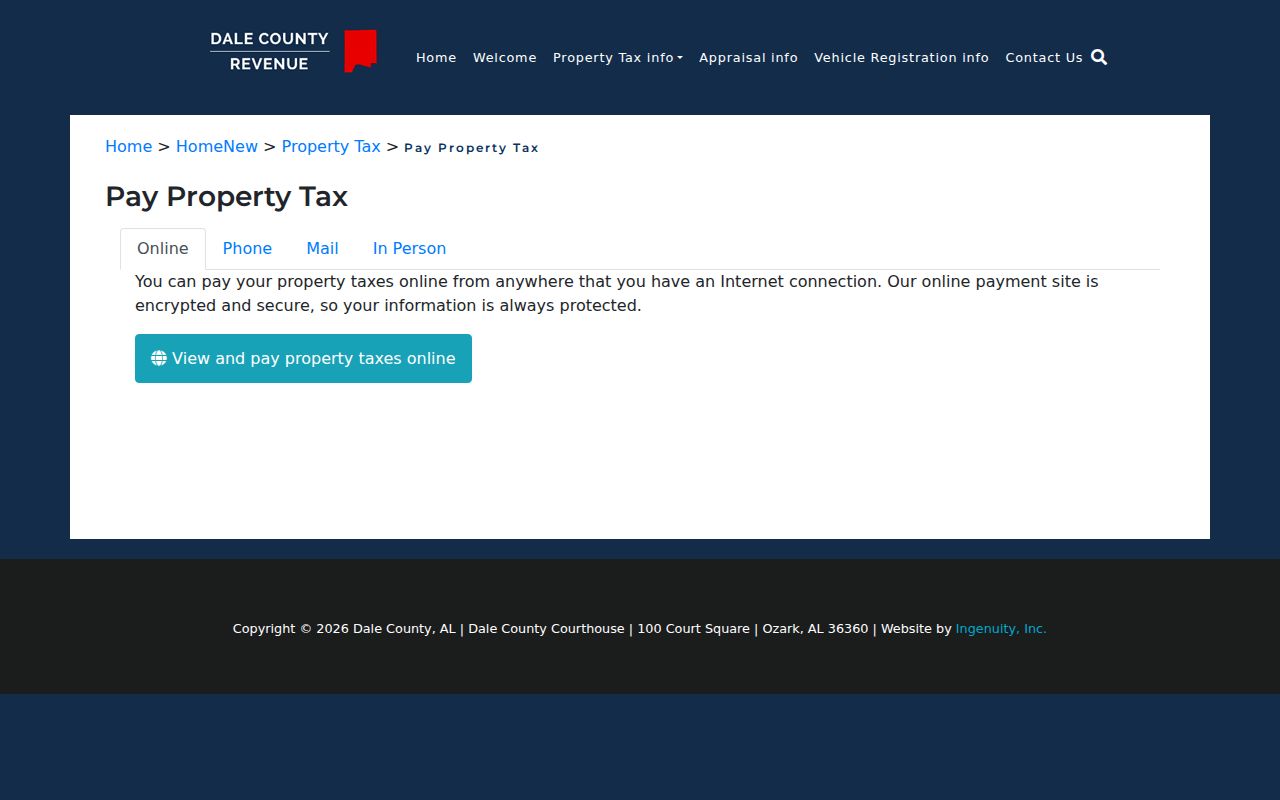
The page confirms the county payment route. Verifying a current bill still belongs to the live account system.
| Channel | Use it for | Fallback |
|---|---|---|
| Dale CAMA | Parcel, owner, value, exemption and annual tax | Appraisal/BPP at 334-774-7208 |
| ALTags Dale Revenue | Tax viewing and online payment | Revenue counter or mail |
| Revenue Office | Account questions, exemptions and delinquency | 100 Court Square, Ozark |
Look Up a Dale County Property Tax Bill
Begin in CAMA when only an address is known. The full parcel number matters there. It cuts confusion between similar street names, helps Revenue find the account, and opens the tax system for the live bill and status.
- Find the parcel by physical address and copy its complete identifier.
- Open Dale Revenue's tax system and read the year, charge and payment status.
- Compare the CAMA exemption code and value components for that same year.
- If delinquent, verify the live list and redemption status directly with Revenue.
- Assessed value
- The taxable fraction after applying the property's classification ratio.
- Levy
- The tax rate applied under the relevant taxing jurisdictions.
- Homestead exemption
- Qualifying relief associated with an owner-occupied home.
- Tax lien
- The statutory claim arising from unpaid property tax.
Follow Dale County's October Through January Calendar
Dale property tax comes due October 1. Taxes turn delinquent January 1. After February, personal checks are no longer accepted. No late fee applies through December 31, so those dates make the tax year essential whenever a CAMA amount is compared with a payment result.
Pay in person by cash, check, money order, or card, by mail, or online with a convenience fee. The county takes no phone payments. Satellite offices keep different hours, carry no-cash restrictions, and close through November and December.
Understand Dale County Tax-Lien Sales
Dale County moved to tax-lien sales with the 2020 tax year under Alabama's statutory process. The auction is annual and online. It runs between March 1 and June 15. Bidding starts from a 12 percent interest rate. Certificates issue within ten business days, and origination, auction, and certificate fees are charged separately.
A certificate grants no immediate ownership. Nor does it automatically extinguish easements, covenants, or other interests; redemption runs through the Revenue Commissioner. The delinquent list is unavailable. Confirm current parcels on the live system.
Keep Dale Tax District and City Labels Separate
A CAMA card can list a city, mailing city, neighborhood, and tax district that point to different geographies. A Woodham Heights card lists Midland City as situs. Dothan appears as its tax district. Record each field separately.
Tax district helps explain the bill. It proves nothing about municipal limits, ownership, or postal geography. When a boundary affects permits or zoning, consult GIS and the city.
Compare Dale Assessment and Recorded Sale Evidence
The CAMA card shows land, building, improvement, and total values, along with the last deed reference. That reference can lead to the Probate instrument. Do not report assessment value as deed consideration. Only the deed itself can support that figure.
A recorded transfer can predate an assessment-roll update. No official Dale source publishes an average lag from recording to the owner field. Keep the deed date, recording reference, and CAMA snapshot date together.
Check Improvements Behind a Dale County Value
Start with the parcel card. It splits a total value into land, the principal building and miscellaneous improvements. A Level Plains example shows how this works. A 2008 pool sits on the card as its own miscellaneous line with a separate value. Small details like that explain why a total moved. The card is a tax record, not a private appraisal. Before any appeal, read the building and land pieces for plain factual errors. Was the pool built that year? Does the card list a building feature the property never had? An appeal lands better when it names the specific parcel characteristic in dispute. A complaint aimed only at the final tax amount is much weaker.
Dates decide almost everything here. The public CAMA route has carried a 2025 label, while a DaleGov revaluation route shows a 2026 label. Never mix them. Pulling a land value from one view and an improvement value from the other produces a total that belongs to no real account. Note the source label, the tax year and the date you accessed it. Compare like fields with like fields. When a current notice conflicts with an older card, the notice and the Revenue office are the better sources for the appeal cycle in progress. Ownership questions cross office lines too. Revenue states that property should be assessed after a deed is recorded in Probate. The owner is responsible for getting the deed recorded, the property assessed, exemptions claimed and the mailing address kept current. The county publishes no fixed number of days for the owner field to change after recording. If a bill still shows a prior owner, retrieve the latest deed, save its recording reference and call Revenue. Do not assume the deed failed. Do not assume the tax account controls title either. Payment status belongs to the live account, not an old screenshot. Mail, courthouse and online payment are the documented channels. Online payment carries a convenience fee. Satellite offices run different schedules, take no cash and close during November and December. Those limits matter. The main collection period begins October 1. No payment is taken by phone. A caller should use the official office number only to clarify an account or payment method, never to read out card details for a phone transaction. Delinquency work needs the same date discipline. The annual lien-sale window, registration dates and parcel list can all change. A prior-year flyer is history, not the current schedule. No live list is available, so confirm the official delinquent page first. Then ask Revenue about redemption, certificate fees and status for the exact parcel. A bidder receives a lien certificate under the county's process. That certificate is not immediate possession. It is not a promise that every other interest has vanished.
Appeal a Dale County Property Tax Valuation
The Dale Board of Equalization hears fair-market-value appeals. For the 2026 cycle, notices were mailed April 9 and the official page gave a 30-day window ending May 9. One appeal per parcel. The filing asks for contact details, parcel identification, an original signature and evidence supporting your requested value. Good evidence fits the stated scope. Photographs, repair estimates and comparable information all work. So do facts showing an error in the parcel characteristics. The scope is fair market value. A general challenge to tax law is not. Check each year's notice, because the dates change.
Appeal window. The 2026 Dale County deadline was 30 days from the April 9 notice date. Verify the current cycle before filing with the Board of Equalization.